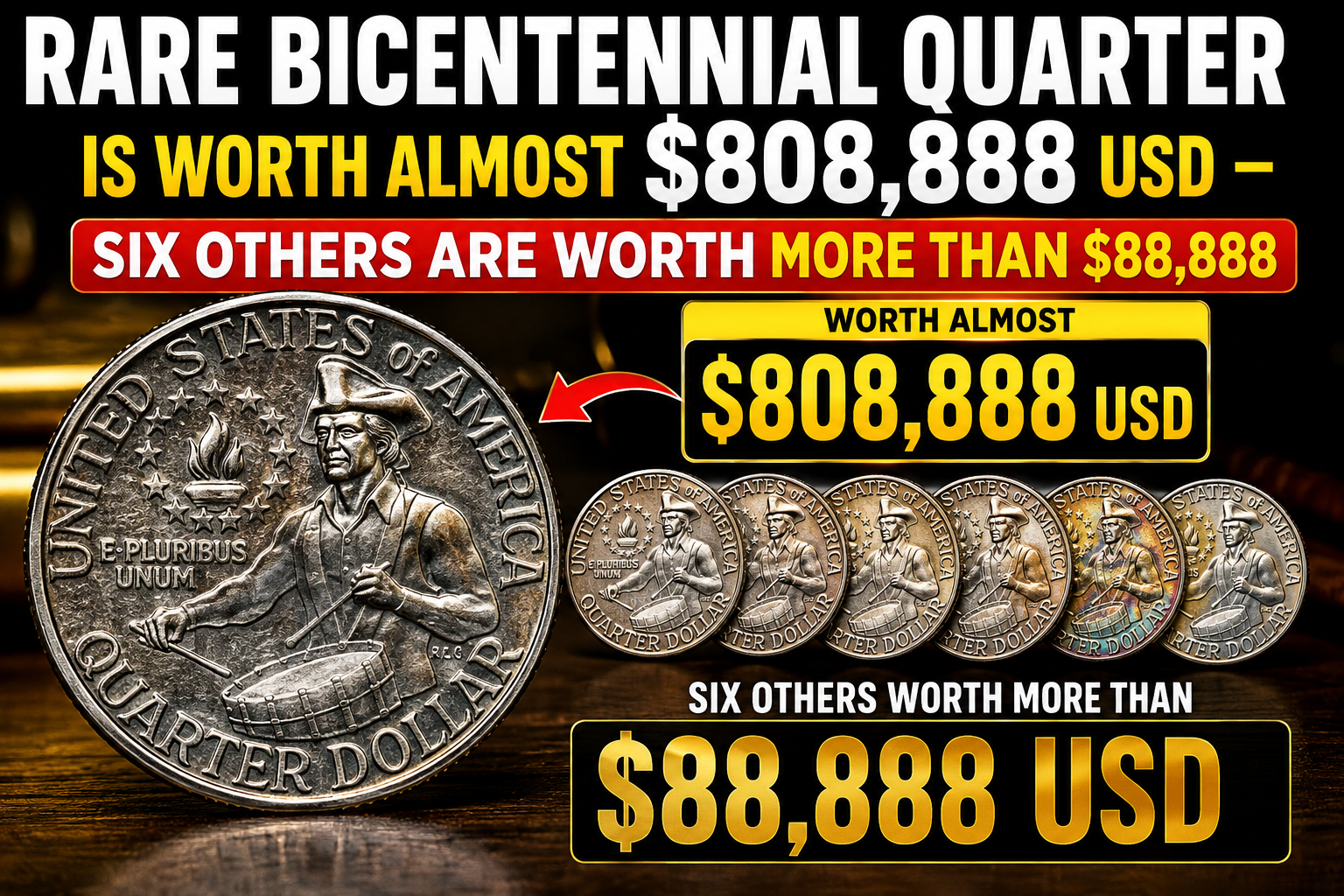
The 1776–1976 Bicentennial quarter is one of America’s most recognizable commemorative coins, featuring the dual date and Colonial drummer design. However, claims that an ordinary Bicentennial quarter is worth hundreds of thousands of dollars should be treated cautiously. Documented sales for genuine rare examples are generally far below the sensational $808,888 figure. Some exceptional errors, silver varieties, and high-grade specimens can nevertheless bring thousands or even tens of thousands of dollars. (Coins Value)
1. The $808,888 Bicentennial Quarter Claim Deserves Careful Verification
A Bicentennial quarter supposedly worth nearly $808,888 would be an extraordinary outlier rather than a normal market price. Available documented records show valuable examples reaching thousands or, for unusual major errors, potentially much higher amounts, but not a routinely established $808,888 valuation. Collectors should therefore verify any viral price claim through reputable auction records, professional grading services, and authenticated sales before assuming their coin is worth a fortune. (CoinValueChecker.com)
2. 1976-D Doubled Die Obverse Quarter Can Be Surprisingly Valuable
The 1976-D Doubled Die Obverse is among the most important documented Bicentennial quarter varieties. Strong doubling can appear around lettering and other design elements, depending on the specific variety. One reported MS66 example reached $8,400 at Heritage Auctions, illustrating how dramatically rarity and condition can influence the value of a seemingly ordinary quarter. (US Coins Value)
3. Wrong-Planchet Bicentennial Quarters Can Command Serious Collector Premiums
A wrong-planchet error occurs when a quarter design is accidentally struck onto a blank intended for another denomination. These coins can look noticeably different because their size, weight, and appearance may not match a normal quarter. Documented examples include Bicentennial quarters struck on dime or nickel planchets, with some authenticated specimens selling for several thousand dollars. (Coins Value)
4. 1976-S Silver Bicentennial Quarters Are Important Collector Issues
San Francisco produced 40% silver Bicentennial quarters specifically for collectors, making them different from ordinary circulating clad examples. Their precious-metal content and collectible status give them additional value, particularly when they remain exceptionally well preserved. One reported 1976-S silver specimen in an elite grade reached $19,200, showing how condition can dramatically increase the value of a scarce collectible coin. (Coins Value)
5. Dramatic Off-Center Strikes Can Become Valuable Mint Errors
An off-center strike happens when the coin blank is not correctly positioned during striking. The resulting quarter may have part of the design missing while leaving a conspicuous area of blank metal. The more dramatic the error—and the more clearly the important date remains visible—the more attractive the coin can become to collectors. Documented values can reach hundreds of dollars or more for particularly impressive examples. (Coins Value)
6. High-Grade Clad Bicentennial Quarters Can Bring Thousands
Most circulated Bicentennial quarters remain common and are generally worth their face value. However, exceptional coins preserved in extraordinarily high Mint State grades can command substantial premiums because collectors compete for condition rarities. A 1976-D clad quarter graded MS68 reportedly sold for $6,462, demonstrating why professional grading can matter when a coin appears nearly flawless. (FindBullionPrices.com)
7. Major Die and Overstrike Errors Are Among the Most Exciting Finds
Some Bicentennial quarters exhibit dramatic minting mistakes beyond ordinary doubling or off-center strikes. Die caps, brockages, double strikes, and unusual overstrikes can attract specialized collectors because their production errors are visually distinctive and extremely uncommon. One documented Bicentennial-related overstrike example reportedly reached $28,200, emphasizing how unusual mint errors can outperform ordinary examples by an enormous margin. (Coins Value)
What Makes a Bicentennial Quarter Valuable?
Collectors typically examine several factors before assigning a premium value:
- Mint mark: Philadelphia coins have no mint mark, while Denver and San Francisco pieces carry identifying marks.
- Condition: Uncirculated and exceptionally graded coins can be worth substantially more.
- Silver composition: Certain San Francisco collector issues contain 40% silver.
- Mint errors: Wrong-planchet strikes, doubled dies, off-center strikes, and other genuine errors can be highly collectible.
- Authentication: Professional certification can help establish whether an unusual coin is genuinely rare.
It is also important to remember that a no-mint-mark Bicentennial quarter is not automatically rare. Philadelphia produced hundreds of millions of these coins without a P mint mark. (Coins Value)
FAQs
Is a 1976 Bicentennial quarter really worth $808,888?
There is no reliable evidence that an ordinary 1976 Bicentennial quarter routinely sells for $808,888. Such claims should be verified against documented auction results and professional grading records.
How much is a normal Bicentennial quarter worth?
Most circulated examples are worth around their face value of 25 cents. Exceptional grades, silver issues, and genuine mint errors can command considerably more. (Coin Identifier)
Which Bicentennial quarter is considered especially valuable?
The 1976-D Doubled Die Obverse, major wrong-planchet errors, dramatic off-center strikes, and exceptionally graded silver examples are among the most interesting varieties for collectors. (Coins Value)
How can I tell whether my quarter is silver?
A genuine 40% silver Bicentennial quarter is associated with the San Francisco Mint’s collector issues. Weight and edge appearance can help distinguish silver from clad coins, although professional testing provides greater confidence. (How Much is it Worth)
Should I clean an old Bicentennial quarter before selling it?
No. Cleaning can damage the original surface and potentially reduce collector appeal. It is generally better to leave a potentially valuable coin in its original condition and have it evaluated professionally.
Where should an unusually valuable quarter be authenticated?
For a potentially significant error or exceptionally high-grade coin, consider professional third-party grading and authentication services such as PCGS or NGC. Authentication is especially important before accepting an extraordinary valuation. (Coins Value)
Bottom line: Finding a Bicentennial quarter in your change is not automatically a jackpot. Most are common, but a genuine mint error, silver issue, or exceptional-condition specimen can be worth substantially more. The key is verification—not viral price claims.

Prakash Kumar is a seasoned journalist and storyteller with 12 years of experience creating clear, engaging news content for digital audiences. His reporting spans automobile launches, emerging technology, consumer gadgets, health and diet tips, and everyday lifestyle trends. Known for turning complex information into useful, reader-friendly stories, Prakash combines careful research with a sharp editorial eye. He follows industry developments closely, interviews experts, and delivers timely articles that help readers make informed choices. Whether covering a new car, a smart device, or practical nutrition advice, Prakash brings accuracy, curiosity, and approachable writing to every story he publishes for news readers.